


The History of the Sepulveda Pass
Every Angeleno knows the feeling. You’re pushing south on the 405, the San Fernando Valley stretching wide and flat behind you, and then the Santa Monica Mountains rise up ahead. The freeway narrows. Brake lights blossom. And then, suddenly, you’re through, cresting the pass with West Los Angeles spilling out below you and the promise of Bel Air, Brentwood, and Beverly Hills glittering just beyond. It’s a passage that tens of millions of people make every year. But almost none of them know the full story of where they are.
The Sepulveda Pass is one of the most storied corridors in all of California, a slot through the Santa Monica Mountains that has served as a vital link between two worlds for thousands of years. Long before there was a freeway, a boulevard, or even a dirt road, there was a footpath. And the people who walked it first left an imprint on Los Angeles that endures to this day.
The First People of the Pass
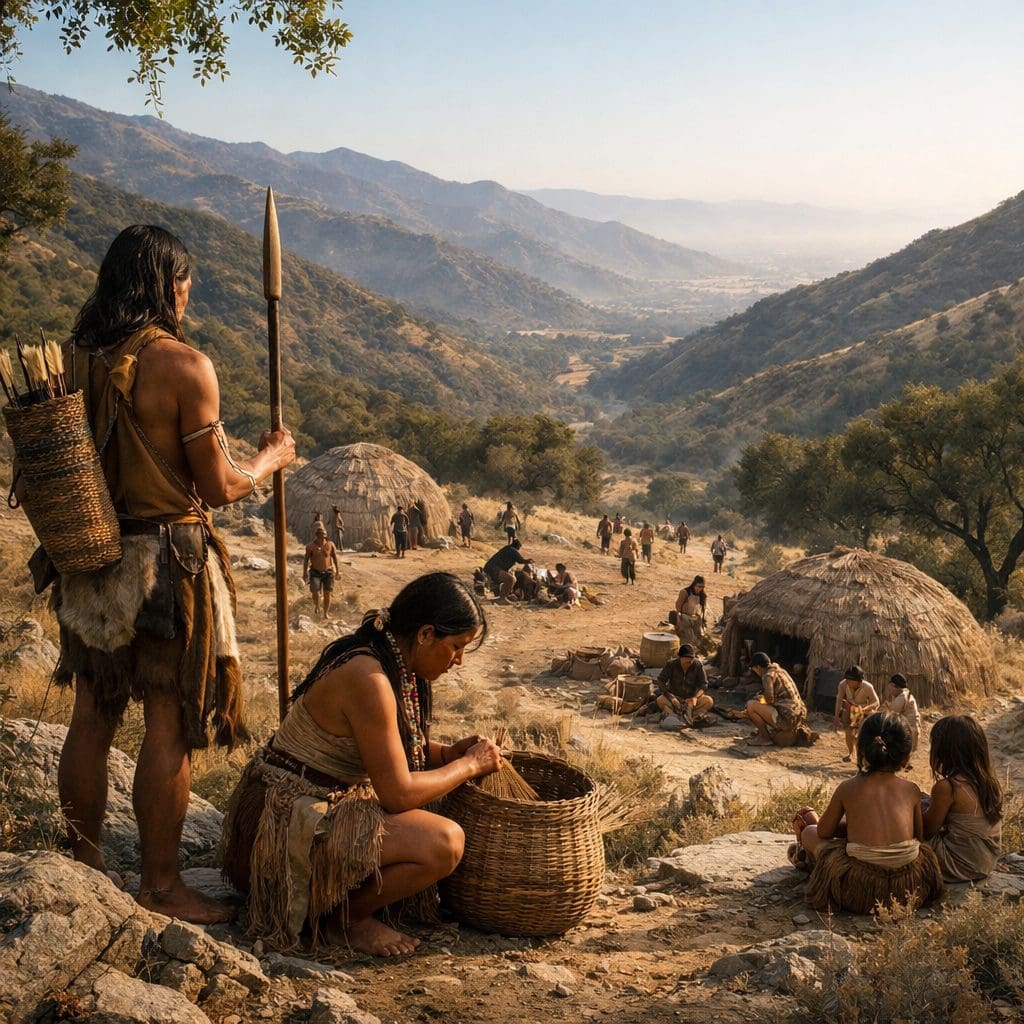
The indigenous Tongva people, also known as the Gabrieleño, were the original Angelenos, inhabiting the Los Angeles Basin and surrounding mountains for thousands of years before European contact. Their territory was the center of a flourishing trade network that extended from the Channel Islands in the west to the Colorado River in the east, connecting them with the Cahuilla, Serrano, Luiseño, Chumash, and Mohave peoples. The Santa Monica Mountains, including the Sepulveda Pass, formed a natural boundary between the inland valleys and the coastal basin, and the Tongva knew every inch of it.
Their footpath through the Sepulveda Basin was, in a very real sense, the original 405 freeway. Runners, traders, and hunters used the canyon passage to move between the San Fernando Valley and what is now the Westside of Los Angeles, the same corridor that today connects communities like Sherman Oaks and Encino in the north to Brentwood, Westwood, and Santa Monica in the south. When the Spanish Portolá Expedition arrived in 1769, pushing north toward Monterey, their soldiers and clergy followed that same ancient Tongva trade route through the pass, a testament to how shrewdly the indigenous people had mapped the landscape. The Santa Monica Mountains hold more than 1,000 archaeology sites of significance, drawn primarily from the cultures of the Tongva and neighboring Chumash, representing over eight thousand years of continuous human presence.
When Mission San Fernando was established in the Valley in 1797, the Tongva world was rapidly upended. Their villages were absorbed, their labor conscripted, and their culture suppressed under the Spanish mission system. Yet the pass itself endured as a thoroughfare, carrying forward the memory of those who first blazed the trail.
The Name Behind the Pass
So where does the name “Sepulveda” actually come from? It traces to one of the most powerful families in early California history. The Sepúlveda family is a prominent Californio family whose roots in Southern California stretch back to 1781, when Francisco Xavier Sepúlveda, a soldier in the Spanish army stationed at Mission San Gabriel, arrived in the region as part of a military regiment. His descendants became one of the most influential dynasties in all of Alta California, holding extensive rancho grants and serving as Alcalde (Mayor) of Los Angeles, State Assemblymen, and County Supervisors.
Between 1809 and 1845, the grandchildren of Francisco Xavier Sepulveda claimed five land grants, ranging from present day coastal Orange County all the way up to the base of the Sepulveda Pass. The Rancho San Vicente y Santa Monica grant included the canyon we now call the Sepulveda Pass. The family name now graces Sepulveda Boulevard, the longest street in Los Angeles County, as well as the Pass itself, Sepulveda Dam, and two Metro rail stations. It is as woven into the geography of Los Angeles as any name in the city’s history.
Building the 405: Moving a Mountain
By the late 1950s, the old boulevard simply could not keep pace with Los Angeles’ explosive postwar growth. Engineers devised an audacious solution: tear the canyon apart and rebuild it as a superhighway. Beginning in August 1960, earthmovers carved a gorge 1,800 feet wide and 260 feet deep through the mountains, accomplishing in two years what might take natural erosional forces two million years.
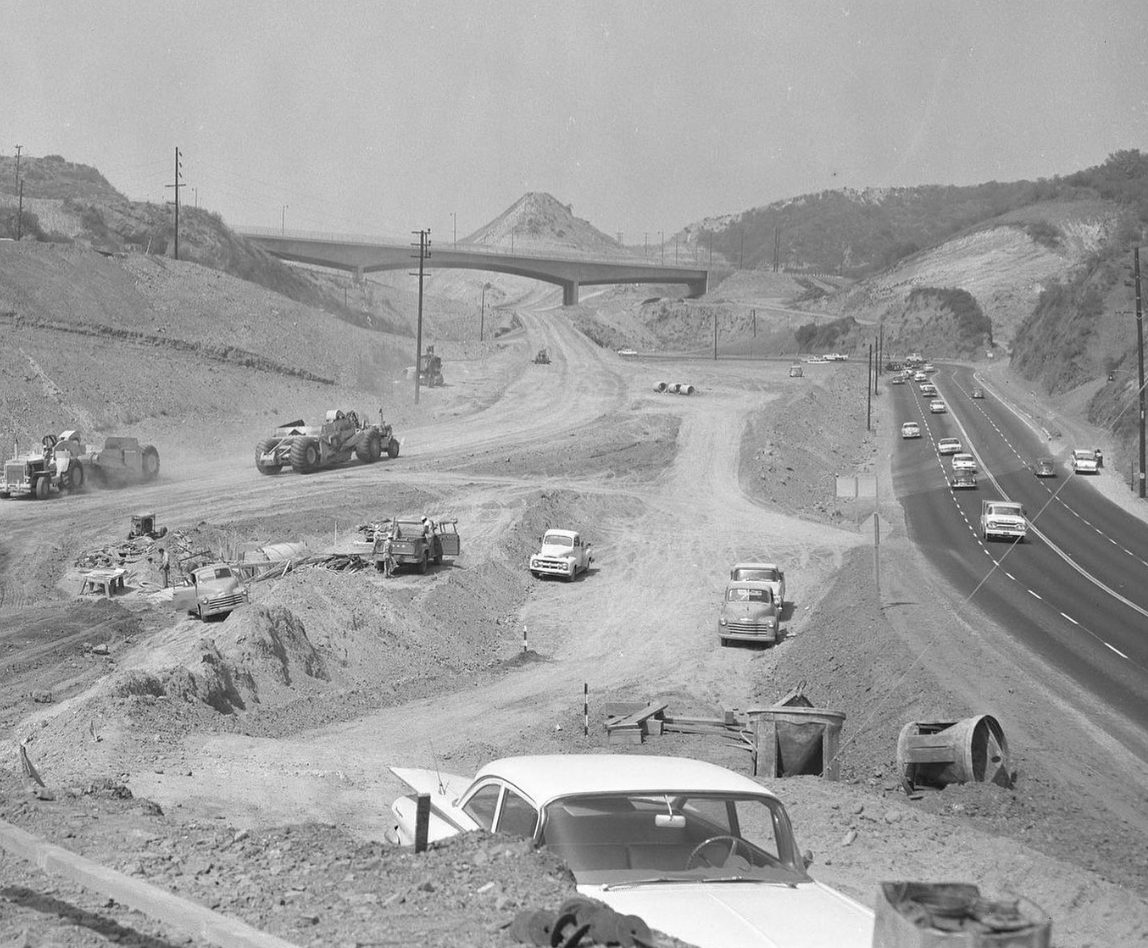
The bulldozers’ total haul: 13 million cubic yards of slate, shale, and dirt. Workers then constructed massive retaining walls to hold the unnaturally steep slopes in place, and reconfigured the area’s natural drainage through a series of culverts.
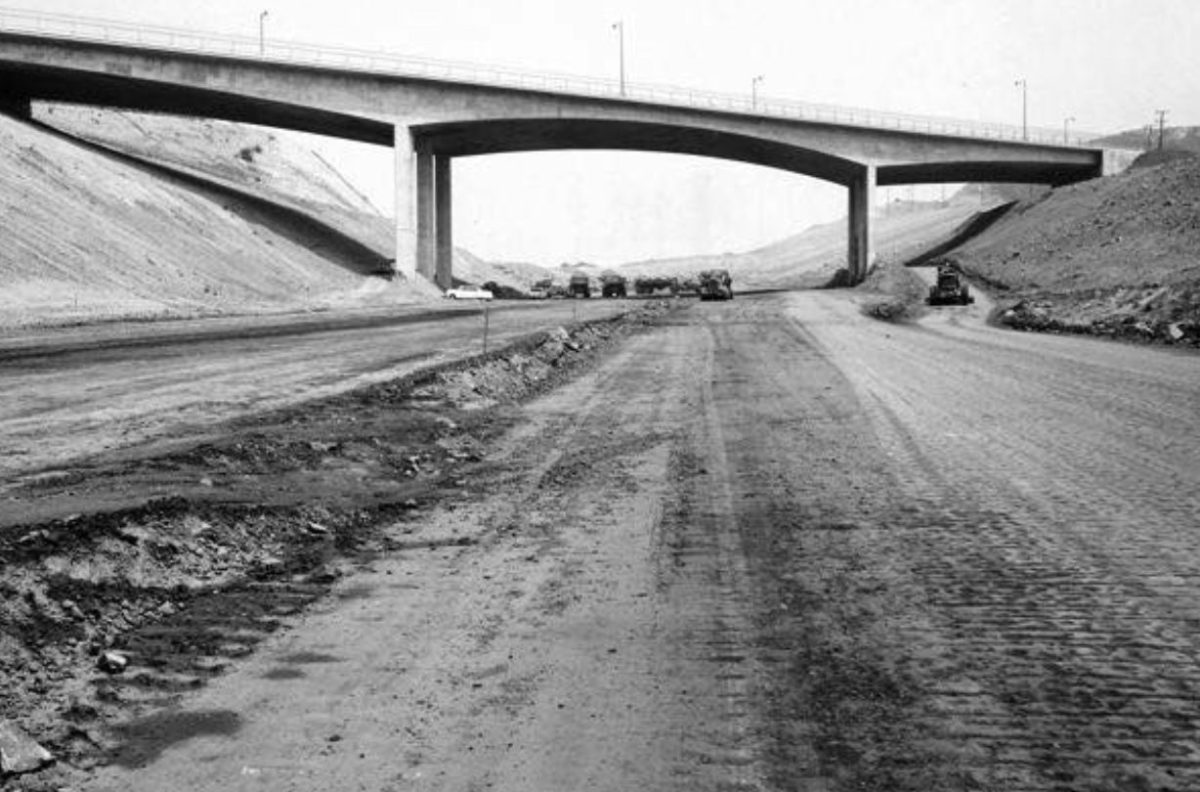
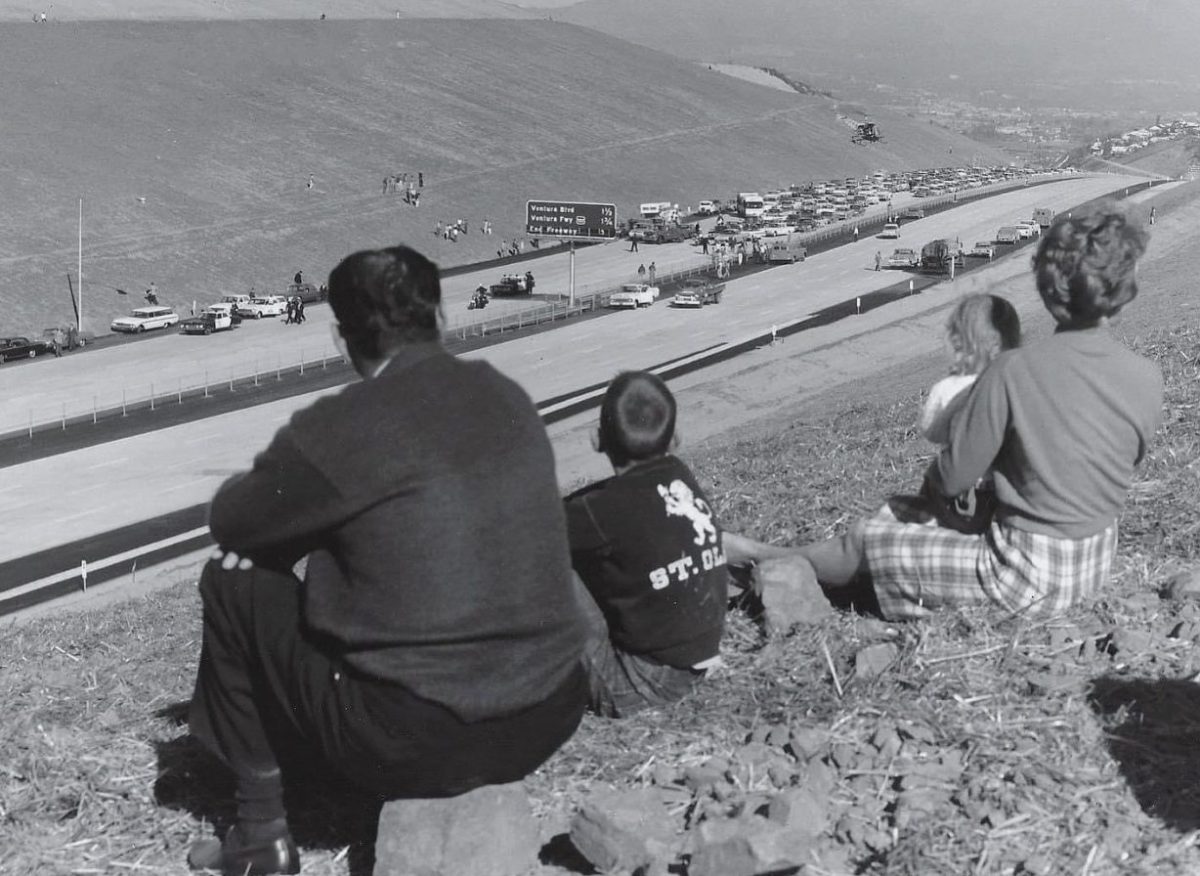
The 5.7 mile section through Sepulveda Pass was dedicated on December 21, 1962, and cost $20 million to construct. It was designed with a maximum grade of 5.5 percent and required the complete relocation of Sepulveda Boulevard and the Mulholland Highway, which was moved 1.1 miles to the south across a new 579 foot long bridge spanning the freeway. In one stroke, a climb that had taken drivers of the 1930s a challenging half hour became a smooth, swift descent through a man made canyon.
The Most Congested Freeway in the Nation
Traffic flowed freely at first, but not for long. The 405 through Sepulveda Pass soon grew into a byword for gridlock, eventually earning a distinction that no city wants but every Angeleno recognizes: I 405 is the busiest highway corridor in the United States, carrying approximately 379,000 vehicles every single day. The Federal Highway Administration has reported that the 405 is the nation’s busiest interstate, and the Sepulveda Pass section is consistently ranked among the most congested stretches in the entire country, and by some measures, the developed world.
The congestion became so legendary that when the freeway was briefly closed in July 2011 for construction work, local media dubbed it “Carmageddon” and warned of apocalyptic gridlock across the entire region. In a very Los Angeles plot twist, so many residents stayed home that traffic was actually lighter than normal. A five year, $1.6 billion widening project completed in 2014 added a carpool lane, but its impact on reducing congestion remains disputed. Planners are now seriously studying a subway tunnel through the mountains as the only realistic long term fix, with a projected opening between 2033 and 2035.
For businesses on both sides of the pass, from medical offices and law firms in Century City and Culver City to corporate headquarters throughout the San Fernando Valley, the chronic congestion makes reliable same-day delivery in Los Angeles a genuine operational challenge. It’s a challenge that A-1 Courier has navigated for nearly 40 years, developing route knowledge and timing strategies that no GPS app can replicate.
That Feeling When You Cross Over
For all the frustration the 405 can cause, there is something undeniably cinematic about the southbound journey through Sepulveda Pass. You climb out of the flat, sun baked expanse of the San Fernando Valley, the freeway rising steadily through the cut in the mountains, and then the canyon opens up and the city reveals itself in layers. Westwood’s office towers catch the light ahead. The ocean shimmers faintly in the distance. And to your right, the hillside estates of Bel Air drape themselves across the slopes like something out of a dream.
There is a genuine electricity to that moment of arrival. You are crossing from one world into another, from the Valley’s sprawling inland grid into the concentrated glamour of the Westside, where Brentwood’s quiet streets, Beverly Hills’ storied avenues, the corporate towers of Century City, the creative studios of Culver City, and the beachside energy of Santa Monica are suddenly minutes away. Angelenos who make that commute every day will tell you they never quite lose the feeling of crossing a threshold. The pass is, in every sense, a gateway. Not just geographical, but almost psychological.
And now you know exactly what you are crossing. A path worn first by the Tongva people thousands of years ago. A canyon blasted open by mid century engineering ambition. A corridor that carries more traffic than any other highway in the United States. And a name belonging to one of the founding families of California itself. The next time you find yourself sitting in brake lights on the 405, inching slowly toward that crest, take a moment. You are part of a very long story, one that began long before the freeway, long before the boulevard, and long before anyone thought to put a name on this pass at all.
And if you need something delivered across it, from the Valley to the Westside or anywhere across our Los Angeles service area, A-1 Courier knows every mile of it. Explore our full range of same-day courier and messenger services and see why Los Angeles businesses have trusted us since 1988.
Need a Delivery on the Westside, or Anywhere in L.A.?
A-1 Courier has been navigating Los Angeles streets and freeways for nearly 40 years. We know every route, every shortcut, and yes, every backup on the 405.
Place an Order